May God bless all who read my ramblings,

Adopt A Catholic Blog

Moreover, as one of the points upon which she had been condemned was the wearing of male apparel, a resumption of that attire would alone constitute a relapse into heresy, and this within a few days happened, owing, it was afterwards alleged, to a trap deliberately laid by her jailers with the connivance of Cauchon. Joan, either to defend her modesty from outrage, or because her women's garments were taken from her, or, perhaps, simply because she was weary of the struggle and was convinced that her enemies were determined to have her blood upon some pretext, once more put on the man's dress which had been purposely left in her way. The end now came soon. On 29 May a court of thirty-seven judges decided unanimously that the Maid must be treated as a relapsed heretic, and this sentence was actually carried out the next day (30 May, 1431) amid circumstances of intense pathos.She actually had dispensation from French bishops to wear male clothing, but this was not recognized by the English inquisitors.
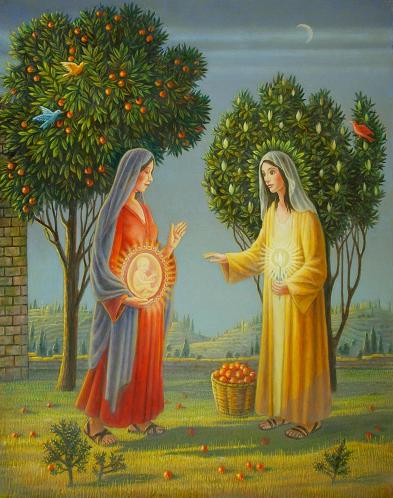 This Saint Quiz isn't meant to be difficult. I really just wanted to do another one. Since I haven't done one in almost a year, so I'll quickly explain that the object is to see who can name the depicted saints in the comment box.
DENIZLI, Turkey (EWTN News) — An archaeological team working in southwest Turkey says it has uncovered the tomb of St. Philip the Apostle.
Italian professor Francesco D’Andria, head of the excavation team at the ancient city of Hierapolis in the province of Denizli, told reporters on July 26 that experts had reached the apostle’s tomb.
Archaeologists had been working for years to find the tomb, he said. They reached the monument while working on the ruins of a newly unearthed church in Hierapolis, the Turkish news agency Anadolu reports. The city of Hierapolis, whose name means “sacred city,” is a UNESCO World Heritage Site. It is famous for its historical hot springs and was used as a spa since the second century. It features a mixture of pagan, Roman, Jewish and early Christian influences.
The structure of the tomb and the writings on it prove that it belonged to St. Philip the Apostle, D’Andria said. He characterized the discovery as a major development both for archaeology and the Christian world.
Just as the sun's rays are sometimes hidden from the earth by thick cloud, so for a while a person may be deprived of spiritual comfort and of grace's brightness. This is caused by the cloud of the passions. Then, all of a sudden, without that person being aware, it is all given back. Just as the surface of the earth rejoices at the rays of the sun when they break through the clouds, so the words of prayer are able to break through to drive the thick cloud of the passions away from the soul.
St. Isaac the Syrian
 Source for the image and explanation of the icon.
 I've set an autopost to show the answer in a week.

 St John Climacus's quote also reminded of Christ's warnings to cut off anything which leads us into sin.


 When I think of St Thomas Aquinas, I always think of the dry philosophy/theology in the Summa Theologica and Summa Contra Gentiles. Today I was scanning thru Catholic Patristics and found this icon. After a quick Google search, I found out that the text on the scroll is apparently of his most famous quotes. I guess he's not all brain after all. Not only that, but it has definitely given me something to think over.


